Parallel Design Study • Parallel Design
Published: September 11, 2026 • Author: Sarah Jenkins

Managing Parallel Concepts

How engineering teams maintain structural clarity, synchronize shared interfaces, and track divergence across multiple concurrent CAD models without losing momentum.

Protocol Metadata Option Fork
Discipline: Mechanical Engineering
Exploration Mode: Multi-Path Branching
Lifecycle Stage: Pre-Convergence
01

Establishing Synchronized Baselines and Common Interfaces

Running multiple mechanical solutions in parallel prevents premature lock-in, but uncoordinated branching rapidly creates chaos in physical fit and assembly interfaces.

When exploring multiple architectures for a mechanical subsystem, the greatest risk is interface drift. As different designers evolve competing kinematics, structural frames, or latching mechanisms, the mating boundaries often diverge inadvertently. A disciplined parallel workflow isolates the core exploratory zone while anchoring outer envelope dimensions, power routes, and mounting datums to an immutable reference master. This ensures that every parallel branch solves the designated mechanical problem without silently breaking adjacent subsystem requirements.
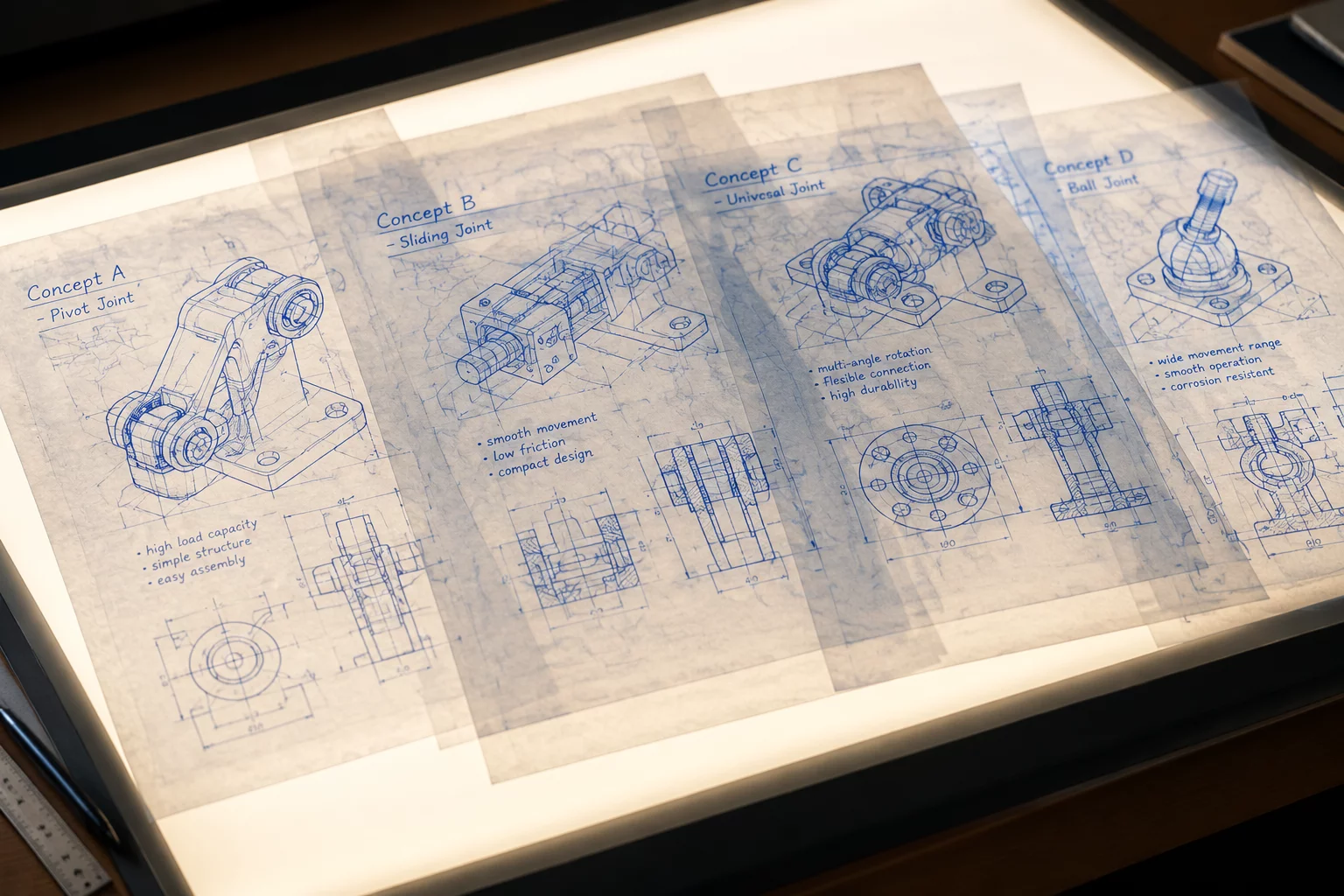
Managing Parallel Concepts
Multi-layer mechanical layout showing synchronized mating references across three concurrent joint architectures.
02

Core Metrics for Concept Health and Comparison

Parallel exploration only produces value when competing designs are evaluated against identical baseline constraints rather than subjective preferences. Establishing quantitative review gates at each iteration prevents teams from over-investing time into structurally unfeasible branches.

Parallel Branch Evaluation Matrix

Maximum Active Branches:
3 concurrent paths per subsystem
Interface Sync Cadence:
Bi-weekly boundary verification
Evaluation Criteria:
Part count, assembly time, tooling cost
Exploration Timebox:
10 working days prior to convergence
Pruning Trigger:
Failure on any primary non-negotiable datum
03

Mitigating Cognitive Fatigue in Multi-Model Development

Developing parallel concepts simultaneously places high cognitive demands on the engineering group. Without clear branching conventions, designers lose track of specific trade-off experiments, leading to redundant work or accidental regression. Clear version notes and focused physical prototypes keep the evaluation objective.

Essential Operating Rules for Parallel Concepts

  • Freeze external mating geometry before branching to keep all options drop-in compatible.
  • Assign explicit failure hypotheses to each branch so unviable paths are pruned decisively.
  • Maintain a unified parameter table for global clearances, fastener diameters, and wall thicknesses.
  • Schedule formal convergence milestones to prevent open-ended concept stagnation.
04

Bridging Exploration to Definite Convergence

The ultimate goal of managing parallel concepts is not to prolong ideation, but to build absolute confidence in the single production path selected. By comparing physical prototypes and simulated stress distributions side by side, the team converts subjective debate into demonstrable empirical evidence.

Receive Our Parallel Exploration Checklists

Get direct access to downloadable CAD branching templates, constraint matrices, and engineering decision sheets.

05

Related Exploration Protocols