Parallel Design Study • Parallel Design
Published: 2026-08-10 • Author: Jessica Lin

Archiving Abandoned Paths

Discarding a concept branch should never mean deleting its engineering history. Preserving failure mechanisms, packaging dead-ends, and trade-off data protects future development cycles from repeating forgotten mistakes.

Protocol Metadata Option Fork
Discipline: Mechanical Engineering
Exploration Mode: Multi-Path Branching
Lifecycle Stage: Pre-Convergence
01

Why Discarded Engineering Concepts Must Be Preserved

When a prototype branch proves unviable during multi-path exploration, the natural impulse is to clean up the CAD workspace and delete the branch. Doing so erases the expensive empirical proof that ruled out that specific configuration.

In hardware engineering, discarded branches contain critical negative data. If team members cannot inspect why a specific snap-fit angle failed or why a dual-hinge mechanism bound under thermal expansion, future iterations will inevitably revisit the exact same flawed assumptions. Archiving abandoned paths transforms exploratory investment into permanent institutional knowledge that prevents circular debates during future design reviews.
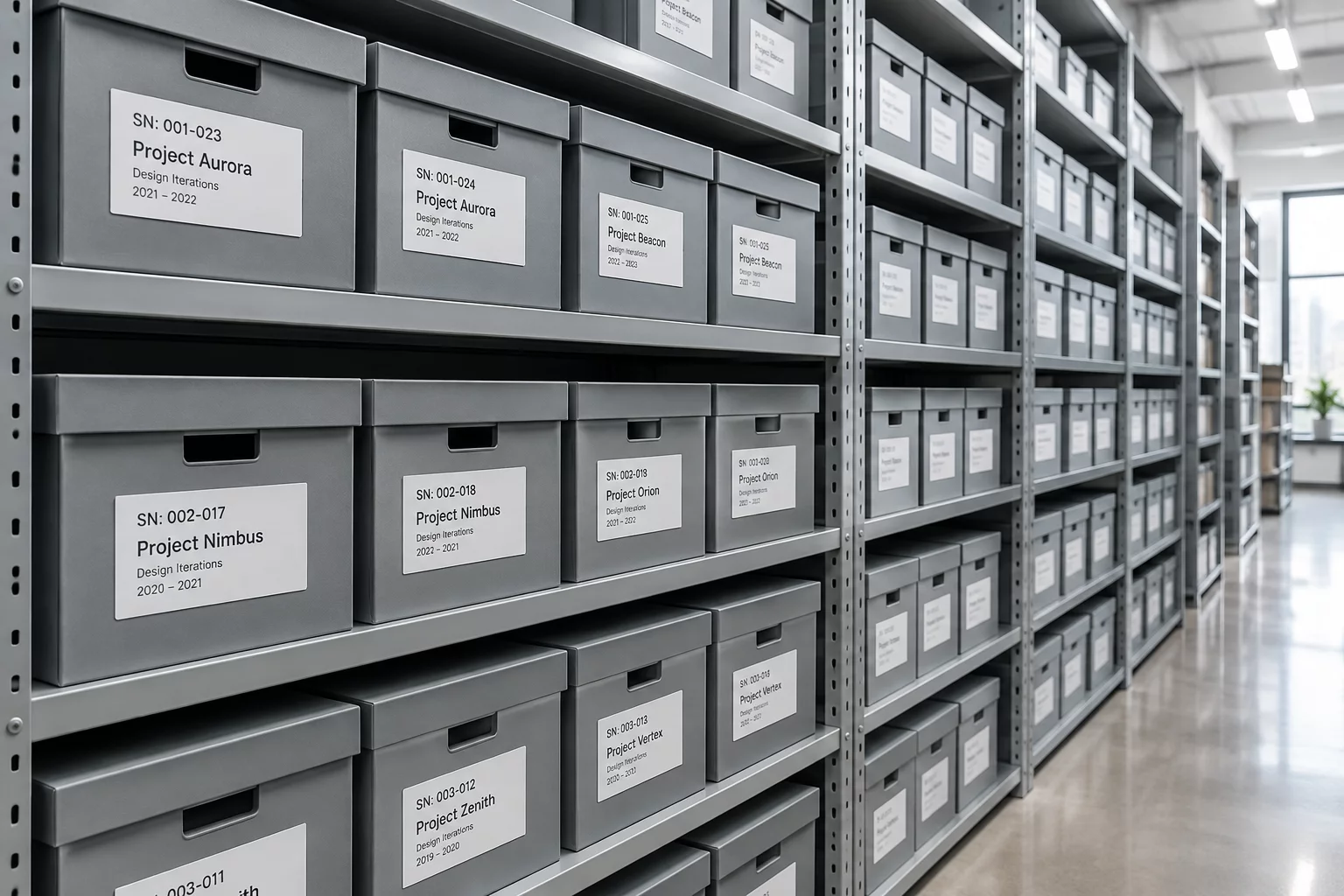
Archiving Abandoned Paths
Structured branch archives preserve CAD snapshots, decision rationale, and empirical failure points for future retrieval.
02

The Technical Breakdown: What to Capture Before Branch Closure

An effective branch archive requires more than freezing an unorganized assembly file. It must capture the core physical limitations encountered, the manufacturing boundaries that proved prohibitive, and the explicit measurable threshold that triggered abandonment.

Core Archival Parameters & Retention Standards

Terminal Failure Mode
Exact physical or manufacturing constraint violated (e.g., tool access clearance < 12mm)
Parametric Boundary Limits
Maximum load threshold, thermal gradient, or part count observed prior to branch termination
Incurred Prototyping Investment
Total hours, physical prints, and tooling expenditure logged prior to formal retirement
CAD State Lock
Read-only milestone branch created with isolated STEP neutral geometry and drawing package
Re-Evaluation Triggers
Explicit criteria required to reopen the path (e.g., tooling budget increase or 5-axis capability)
03

Practical Guidelines for Clean CAD and Logbook Archiving

Cluttering active assembly trees with obsolete components causes severe modeling latency and mate errors. Conversely, burying failed iterations on personal drives ensures no other engineer benefits from them. Maintaining a disciplined archival protocol keeps primary workspaces clean while preserving rationale in a searchable index.

Archiving Best Practices for Hardware Teams

  • Freeze a clean milestone revision in cloud CAD before suppressing mates or stripping features.
  • Attach a one-page decision brief detailing the exact quantitative reason the path was abandoned.
  • Export neutral formats (STEP and Parasolid) alongside native CAD files to prevent future software incompatibility.
  • Index the retired branch with functional tags such as thermal dissipation, latching mechanism, or sheet metal bending.
04

Implementing the Archival Workflow Across Sprint Cycles

Incorporate an explicit 'retire or graduate' review at the close of every parallel concept milestone. When an engineering team formalizes path retirement as a valuable discovery rather than a design setback, engineers document edge cases thoroughly and accelerate convergence on the winning production architecture.

Refine Your Parallel Exploration Process

Subscribe to our technical newsletter for engineering case studies, convergence frameworks, and CAD branching workflows delivered monthly.

05

Related Parallel Design Protocols